For Local Businesses, the Importance of a Google Business Profile Can’t Be Overstated
At Armada Digital, we frequently highlight the value of an optimized, user-friendly website that communicates your brand and converts visitors to customers. However, there’s one other marketing cornerstone that is just as important, if not more so, specifically for local and service-based businesses: your Google Business Profile.
While a good website will attract and draw in visitors, Google puts heavy emphasis on Maps and Local Business Packs in search results, with the goal of helping users make a decision right from within their interface. That means in many cases potential customers will choose who to call directly from their search.
To reach these customers, local businesses in the home services, trades, and even professional services must have a well-optimized Google Business Profile. Here’s why the GBP is so critical for multiple parts of your SEO and digital marketing strategy—and what you can do to improve your visibility.
Why a Visible, Optimized GBP Means Everything
There are several reasons why updating and optimizing your GBP is essential for local and service-based businesses. Some are based on metrics, while others are simply logical benefits of maintaining your online footprint.
Map Results Are Near the Top of Local Search
When users search for anything with potential local relevance, Google’s search results pages will nearly always feature Maps results near the top in what’s called the “Local Pack.” The Local Pack is that section of the search results page with a section of Google Maps and three top local businesses highlighted.
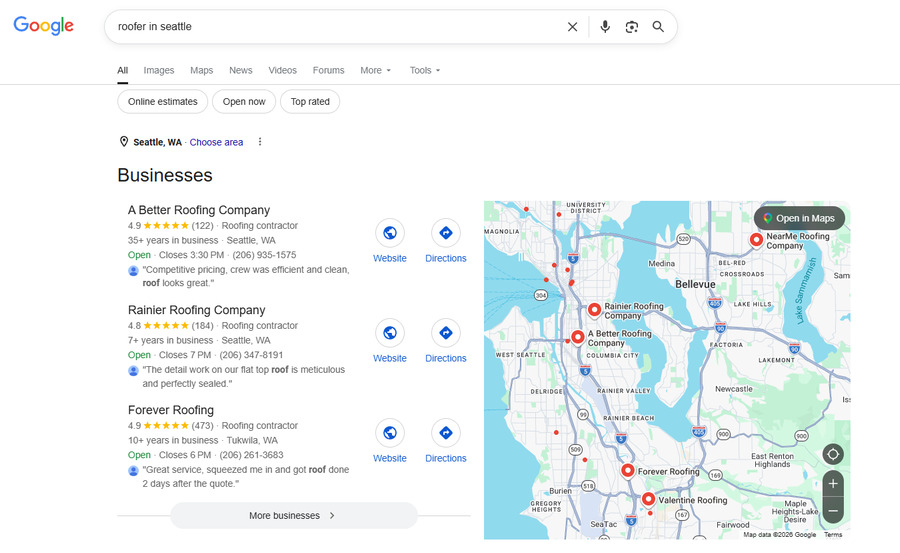
This Local Pack can be placed at the top of search results (particularly if users have an adblocker), or just below local ads and PPC placements—more on ads in a bit. Customers will often make calls directly from these Local Pack results.
But the bottom line: The only way to show up in this crucial position is by having a strong Google Business Profile with complete information and a high volume of 5-star reviews.
…and Local Search Is Increasingly the Default
So when customers make locally relevant searches, the Local Pack is a critical place for businesses to show up. Years ago these were merely a subset of all searches—but now, local search is a much larger slice of the pie by default.
Today, what Google considers “local” includes both searches that include location information and cues (such as searching for “electricians near me” or “plumber in Chicago”) and searches that Google assumes are local. That is, if you simply search for “roofers,” Google will show you geographically close results even without specifying “near me.”
After all, why would you want just any roofer instead of one in your immediate area?
What this means, though, is that more and more searches are being tied to location, giving businesses more opportunities to rank with their Google Business Profile.
Grow Visibility, Not Just Traffic
Showing up in Local Packs drives huge amounts of traffic, leads, and business for many companies. Calls straight from Google Business Profiles may be the biggest source of leads next to your website, and a high volume of website traffic often comes from customers clicking through the link in your GBP.
However, even if a customer doesn’t click or convert, simply being visible is essential.
Sometimes, customers like to spend time evaluating different companies before making a decision. If you show up in Local Packs frequently, they’ll see your business more often, which makes them more likely to remember your company and search for you again in the future.
Yes, It Matters for AI Too
We’ve previously covered why AI isn’t killing search. Much of the answer boils down to the fact that AI search results care about many of the same things Google’s algorithm has been trending toward, and the fact that being indexed is always—and ranking high is often—a prerequisite to being shown in AI results.
Well, much of the same is true when it comes to AI results for local searches and your Google Business Profile. Google’s AI Overview pulls strong Google Business Profiles into its summaries, so while for some searches the Local Pack may be bumped down on the page, the same performance factors are influencing which businesses Google AI highlights.
After all, current iterations of AI love structure, and GBP data is highly structured and predictable.
Your GBP Even Supports Ads
Beyond visibility in local organic search results and AI summaries, the strength of your GBP also directly impacts ad performance—specifically with Google’s Local Service Ads (LSAs).
For one, a verified Google Business Profile is a prerequisite for running LSAs at all. If your GBP is suspended, incomplete, or unverified, you cannot run this type of ad.
Beyond that, the same factors that affect your Google Business Profile’s appearance in local search results affect performance in LSAs. This is because LSAs are based on trust and quality, just like rankings on Google Maps.
So good reviews, responsiveness, and information that is complete, accurate, and consistent all impact how often your business will be shown when using LSAs.
Your Website Ties In
Based on the above, it’s difficult to overstate the importance of a healthy Google Business Profile for local and service-based businesses who want to drive online leads in any meaningful way. However, that doesn’t mean optimizing your GBP should be your sole focus, especially not to the detriment of your website.
Why? Because the quality and alignment of your website also impacts the strength of your business profile.
While your business profile alone can generate some authority, a website with a strong presence in search and a long track record can significantly boost your GBP, sending authority signals back to the profile.
Alignment is perhaps the most crucial. Nowadays, in local search, Google is looking for consistency in the information it finds about local businesses—the same name, address, phone number (called NAP), but also within services and other business info. If your addresses don’t match or Google finds eight different phone numbers across your website, it can hurt your business profile’s visibility as Google may not trust it as much.
Finally, there’s a third, non-algorithmic way your website still matters: what do customers see when they click through your profile? If they visit a website that’s slow, ugly, or generally unprofessional, they’re less likely to reach out. But a highly functional website that effectively communicates your services and tells your company’s story will help move undecided customers over the line.
So the bottom line is pretty simple: A strong website can rank on its own, and so can a strong Google Business Profile, given the right level of competition in your area or industry. But a business with a well-optimized website and Google Business Profile will see exponentially more leads in search overall.
After all, when you break down the full page of search results, both your GBP and your website have spots where they can rank—and they each support each other.
Best Practices for Optimizing Your Google Business Profile
While you can’t control everything about your Google Business Profile, there are still several things local businesses can do to put their profile in the best position to rank within their service area.
Create or Claim Your GBP
A GBP will often be created automatically for your business after it’s been in operation for long enough. If that hasn’t happened yet, or your business is brand new, you’ll need to create a profile. Otherwise, you’ll need to claim the profile by proving ownership.
Google has documentation on how to do both.
Ensure Consistent Name, Address, Phone Number (NAP)
Your business name should always be written out the same way across your GBP, website, and other local listings you can control. In other words, if your GBP has “Acme Roofing Company” as your company name, avoid using “Acme” or “Acme Roofing Co.” elsewhere as much as possible.
Fill Out Secondary Information
Besides your business name, address, phone number, and hours, a Google Business Profile provides several spaces to add further information about your business. It’s a good idea to make use of this space to the extent possible. Here is some of the secondary information you’ll want to add:
Categories
Choose a primary category for your business that most closely matches the most critical services that you offer. Then, add secondary categories that are relevant.
While you can choose up to 9 (for 10 total categories), do not choose categories that aren’t fully relevant to your business just for the sake of having more.
Services
Next, fill out all the services that you offer. The language you use to describe these services should match your website.
Description
Lastly, write a complete description of your business. This description should be accurate, using your full business name, and include mention of your core services, location, and differentiators.
Images
Imagery is a great way to complete your Google Business Profile and make it feel complete, professional, and up-to-date.
You can include as many images as you like. Some of the most valuable types of images to include are:
- Your storefront (if you have one)
- Business interior (if customers enter your business)
- Current logo
- Company vehicles
- Team
- Services being rendered (i.e. a plumbing inspection, roof repair in progress, etc.)
- Products you sell, install, or partner with
Create a System for Reviews
Last, but very much not least, local businesses should have a system in place for earning, requesting, and responding to reviews on their Google Business Profile. Reviews are a key differentiator that take time to build up, so starting early and having a system are essential.
Request Reviews
Common ways to garner more reviews include some kind of automated email or text that is sent out to customers after they receive a service from your company. This automation should include a direct link to your Google Business Profile and encourage the customer to submit a review that mentions the services they received.
Remember, though: reviews cannot be compensated in any way per Google’s terms of service. This means that offering customers a gift card, discount, etc. is not permitted and could result in action against your Google Business Profile if found out.
Respond to Reviews
When you receive reviews, respond to them promptly. These responses can be formulaic, but should not be copied and pasted. A few pointers on responses are:
- Include the customer’s first name, or what’s visible on their Google profile (even if you know their full name, some customers may prefer this not be used publicly)
- Thank them for the review and for engaging your services (acknowledge the service provided but don’t go overboard on keywords)
- Add any personal touches or details if you remember
- Write about 2–4 sentences total (i.e. not just “thank you for the review!” but not a novel)
Negative reviews are also crucial to respond to. For these, aim to be empathetic and move the conversation offline. Do not be publicly aggressive or confrontational, even if the customer was in the wrong.
Armada Digital Agency Is Here to Help Build Your Local Presence
Managing and maintaining your GBP may seem like a lot, but it’s vital for businesses looking to build a more significant presence in local search. Still, while local businesses may understand the importance of a complete and optimized Google Business Profile, knowing and and executing are two very different things—especially when you have a company to run already.
At Armada Digital, we include GBP management as part of our full suite of SEO services designed to maximize your visibility across all parts of search. We help companies looking to grow their online leads through dynamic strategies that keep pace with Google’s constant changes.
If you’re struggling to build a foothold online, we’re here for you! Get started with an SEO audit and exploratory today.