Sorting Out AEO vs. GEO vs. SEO—and All the Acronyms
If you’re a business owner, there may never have been a more confusing time to be choosing digital marketing strategies. Not only are the classic channels like social media, SEO, and Google Ads vying for your marketing budget, but now agencies are cropping up everywhere telling you SEO is dead and offering you a slew of new acronym-based services—GEO, AEO, AI SEO, LLMO, EEAAO (okay maybe I’m just having flashbacks to 2022-23 Oscar season on that one).
The point is, if you’re trying to zero in on simply showing up more online, how do all of these services differ, how do you know which ones are worth investing in compared to bread and butter SEO… and which ones might just be snake oil?
As it turns out, while many of these acronyms do refer to real concepts, the reality is that any modern SEO company should be on top of the recent radical changes to search, and most have been updating their strategies for months to include practices that help to boost your visibility in AI searches.
This post is a lot of things—it’s a glossary, it’s a history lesson, it’s a vent about scuzzy marketing practices, it’s a position statement for our agency, Armada Digital—but most of all, I hope it’s an informative breakdown of AEO vs. GEO vs. SEO that helps businesses trying to build visibility and drive leads online.
What Is AEO?
AEO stands for “answer engine optimization,” and it refers to optimization practices that increase the likelihood of content being pulled in and used as direct answers to questions users ask.
While the AEO term wasn’t frequently used, this practice existed before AI search became prevalent, as brands would attempt to get pulled into the “People Also Ask” section of search. Now it generally refers to getting information from your website pulled into Google AI summaries, voice search answers, and similar results.
What Is GEO?
GEO is “generative engine optimization.” It describes practices that make content easier for AI tools to read, summarize, and ultimately cite.
This includes best practices in terms of appropriately structuring content for scannability, using Schema markup, building site authority, and answering questions directly, succinctly, and factually.
AEO vs. GEO
AEO and GEO have some overlap, in that for both of these the ultimate goal is to boost visibility in AI searches. In fact, some of the best practices mentioned for GEO—such as directly answering related questions—simply sound like AEO.
In general, you can think of the difference between these as “GEO is about building your website’s authority and structure for AI search, while AEO is about getting pulled in for specific answers.”
Are AEO and GEO Real? Are They Different from SEO?
Let’s take a step back. AEO and GEO are terms that emerged seemingly out of nowhere, have very fuzzy and sometimes overlapping meanings, and yet are pushed hard as new service arms by some companies. But are they even real?
To an extent, yes. AEO and GEO are real concepts that refer to sets of practices intended to help brands and their websites appear more in AI results—whether it’s Google’s AI Overviews, ChatGPT, Claude, Perplexity, or anywhere else.
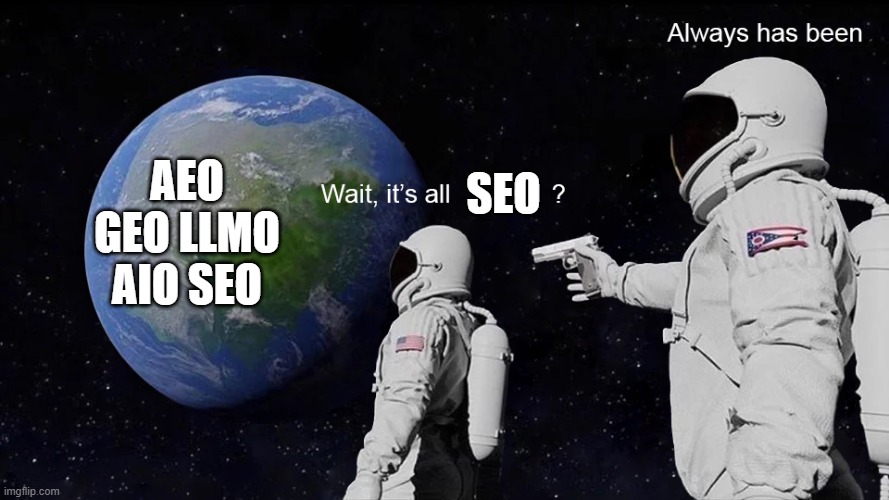
However, these practices are not as distinct from SEO as some marketing agencies (many trying to sell new, overpriced services) would have you believe. A decent parallel to AEO, GEO, and similar acronyms would be “Local SEO,” “Technical SEO,” “On-site SEO,” and the many other types of optimization that fall under the SEO umbrella.
You don’t have to take our word for it—that’s exactly what Google says, too, in their AI Optimization Guide:
“[AEO and GEO] are both terms you may see used to describe work specifically focused on improving visibility in AI search experiences. From Google Search’s perspective, optimizing for generative AI search is optimizing for the search experience, and thus still SEO.”
In other words, while there are new practices to go along with the advent of AI search, ultimately those new practices still aim to optimize for search—that is, they’re still SEO.
A Really Big Algorithm Update
Some folks may remember the early days of SEO, when “black hat” tactics like stuffing pages full of the same keyword dozens of times and adding blocks of hidden white-on-white text were a ticket to fast success.
Or when Google was extremely literal with its searches, and it was a common practice for a roofer to have three separate pages optimized individually for terms like “roofer,” “roofing contractor,” and “roofing company”—because Google didn’t yet understand that those terms are functionally the same.
Google Search evolved years ago with algorithm updates—Penguin and Hummingbird, to be exact—that turned search upside-down. Each time, SEO experts had to adjust to these new best practices. But while the practices changed, what they were doing was still fundamentally SEO.
The addition of generative AI to Google Search and the advent of LLMs like ChatGPT and Claude has simply created a new era of search, much like a really major algorithm update.
AI has ratcheted up how semantic search is to new, higher levels. It means that brands need to shift their focus—but modern SEO service providers now incorporate these new AEO and GEO practices into their overarching SEO strategy.
How AI Has Changed—and Not Changed—Search
AI has undeniably altered the search landscape, but many best practices for appearing in AI summaries and results from ChatGPT, Claude, and the like are continuations of earlier trends. Here are some examples of best practices recommended within AEO and GEO that originate from plain old modern SEO.
Structure Your Information
Content that is better-structured and more scannable tends to perform better in AI results. This includes both the formatting of the content itself—breaking content into shorter paragraphs, adding bullet point breakdowns, organizing sections with descriptive subheadings—and potentially adding things like Schema markups.
In addition, it’s important for information across multiple pieces of content or multiple sources to be the same. For example, facts about your business should always be consistent no matter where that information is located.
The SEO Origin
The Google Search algorithm has long valued creating a good user experience, which includes readability of content. Endless walls of text haven’t performed well in search for a long time; instead, SEO experts focused on breaking topics down in a way that is pleasing to both web crawlers and human users.
And that consistency of information? Streamlining your NAP (Name, Address, and Phone number) has been a core fundamental of Local SEO optimization for a long time.
Prioritize Content Depth
When a user asks a question of an LLM, it aims to provide an in-depth response that covers not just that query, but the implied intent that goes with it. It attempts to anticipate follow-ups and understand surrounding context to provide a more accurate, complete answer—a process called “query fan-out.”
In addition, people often search differently when using an AI tool vs. a search engine, with queries that may be an entire sentence long vs. a simple question.
This means that content that goes more in-depth tends to perform better, as AI tools see that you have provided information not just on the overarching topic, but key subthemes and related questions that the user may also be interested in. Rather than writing a short blog post that answers one single question, it’s typically better for brands to create in-depth pieces that cover both the broad topic and many of its related questions.
The SEO Origin
Before AI search was rolled out, SEO studies had begun to show that longer content often performed better in search. This didn’t mean simply stuffing blogs full of 1,000+ words of fluff nonsense, but taking a topic and covering it in its entirety, providing genuine value to users.
This was a significant contrast to earlier days of search, when it might have made sense to write separate pieces of content on each question and subject within an overarching topic, rather than one comprehensive piece.
SEO moved steadily from creating fractured pieces of content answering individual questions to central “pillar” pieces of content supported by smaller pieces—to, now, making those pillars even more central and comprehensive.
Build Authority Everywhere
When AI tools gather information about a brand, service, or product, they look at many sources. That means it’s important for your brand to have a consistent, authoritative presence in many places on the internet, not just one.
Your social media platforms should consistently and accurately reflect your vision for your brand. It also helps for your brand to be mentioned by third parties, illustrating that it’s not just your own media singing your praises.
The SEO Origin
Google recently began indexing social media content, and backlinks have long been a major contributor to a website’s rankings.
While much of link building occurs naturally over time, backlinks can also be built through outreach. Having a broader link profile signals to Google that your website is more trustworthy—just as it does now for LLMs.
In other words, SEO was already helped by efforts beyond your website.
The list goes on, but the point is that many practices recommended to be more visible in AI searches are drawn straight from the modern SEO playbook, just with a new label.
Are AEO and GEO Worth Investing In?
I don’t want to come off like a tinfoil hat guy, but as much as our agency strives to be the good in marketing, there are plenty of companies out there that exemplify why many people are rightfully skeptical of marketers.
As soon as AI results were added to search, service lines and even entire companies appeared in droves to offer AEO and GEO solutions. Marketers everywhere made fearmongering claims that SEO was irrelevant and your brand would fade into obscurity if you didn’t call on their services.
Of course, not all marketing companies mentioning AEO and GEO are trying to con you. Most aren’t. Now that the terms are out there, the marketing industry has adjusted its terminology to meet potential customers where they’re at. Heck, we’ll probably do the same thing, just with all of this context behind it and couched within SEO fundamentals.
The reality, though, is that while AEO and GEO are real terms with definitions, they fall under SEO and are simply part and parcel of a decades-old goal: making your brand more visible online.
If it helps, you can think of SEO as “search everywhere optimization.” But in reality, it’s just that Google’s “search engine” has been continually expanding its scope beyond the little search box and the blue links everyone’s known for years.
So while it’s good to ask your marketing company about how they’ve updated their practices for AI search, you shouldn’t need to invest in separate AEO and GEO services.
You Don’t Need an AEO or GEO Company—You Need an SEO Company
AEO and GEO success depends heavily on appearing in search results. As Google explains, “generative AI features on Google Search are rooted in our core Search ranking and quality systems.” Put another way: if you aren’t ranking, you probably aren’t being cited.
Similarly, other LLMs can’t find your website and its pages if it isn’t being indexed, and they aren’t going to dig up your website from page 10 of Google to pull it into their results very often.
SEO companies know how important it is for brands to appear in AI search results. And with all the changes made to Google’s algorithm over the years and decades, we know how to adjust to constantly changing best practices to build visibility for brands—and maintain the visibility they’ve achieved.
At Armada Digital, we’re constantly updating our practices to appeal to algorithm updates, AI features, and other shifts in the search landscape. Our team isn’t here to sell you trendy services; we’re here to help your brand navigate the choppy waters of online visibility and bring in digital leads.
If that sounds good to you, reach out to our team to schedule your exploratory today!